

Recently, the UK government confirmed a formal target to grow rail freight by at least 40% by 2040 and 75% by 2050, which will move an estimated extra £15bn a year through the network, on top of the £34bn it already carries. But the announcement isn’t the only thing pushing freight towards rail right now. Fuel economics and a persistent driver shortage are pulling in the same direction, from entirely different causes. That convergence, more than the target itself, is what UK logistics operators need to be planning around.
Three pressures, one direction, no shared cause
It’s worth separating out what’s actually happening here, because these aren’t three symptoms of one trend. They’re three independent developments that happen to be pointing the same way.
Government policy has set a direction.
Great British Railways’ growth target isn’t a hope or an ambition. It’s a formal mandate to shift a meaningful share of UK freight onto rail over the next 15 to 25 years. £15bn a year is a lot of additional volume to absorb into a network that already moves £34bn worth of goods annually.
Fuel economics are quietly rewriting the maths.
Diesel and WTI crude prices have both risen roughly 28% since the Iran conflict began. As Baird & Co analyst Daniel Moore has pointed out, intermodal is roughly 70% more fuel-efficient than traditional truckload. Which means every fuel spike widens the cost gap in intermodal’s favour rather than narrowing it. Logistics UK’s latest quarterly tracker backs this up at the sentiment level too: confidence has climbed from 5.8 to 6.5, with financial health nudging upward alongside it.
The labour market is forcing the issue.
44% of operators still can’t find enough drivers. That shortage is pushing freight onto rail out of necessity as much as preference. Not because every shipper has been won over on the merits, but because the truckload alternative is getting harder to staff.
Growth driven by a single lever tends to be fragile. Ease off the lever, and the growth eases off with it. Growth pushed by three unrelated catalysts is much harder to put back in the box. None of this was planned by any one operator’s roadmap. It’s arriving on its own timeline, from outside any single company’s control.
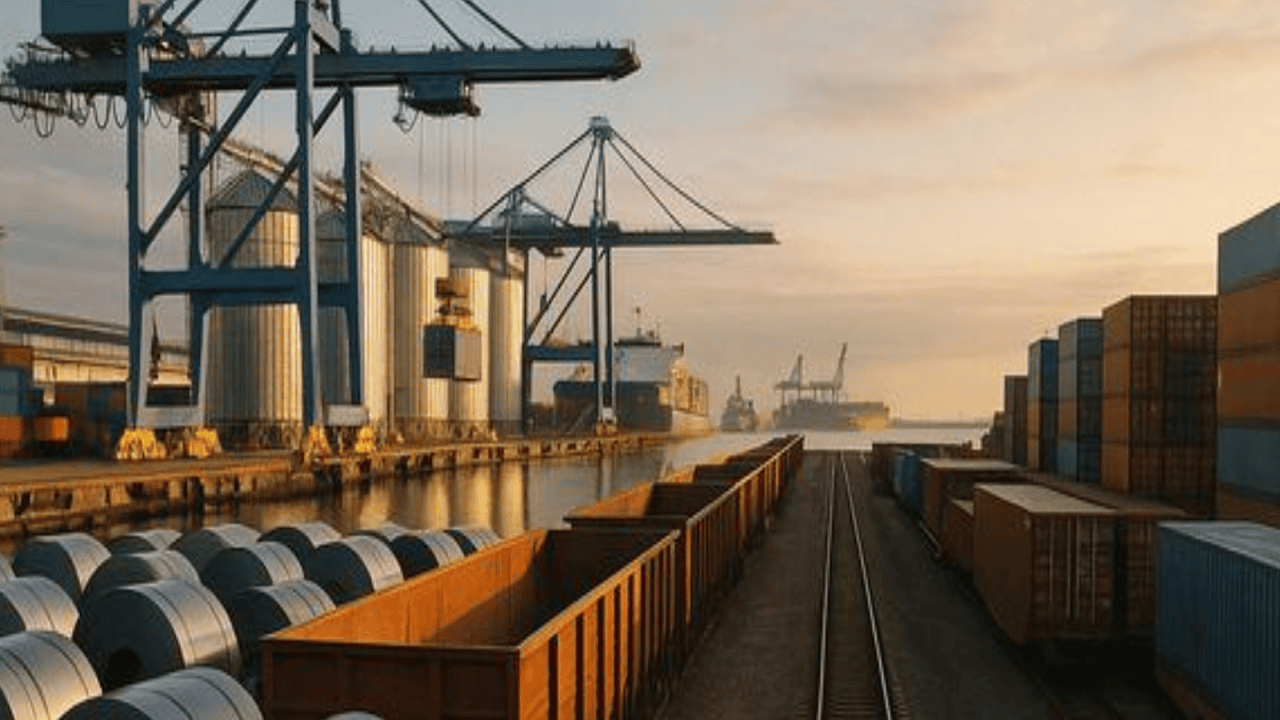
The real challenge isn’t demand.
Given all that, it would be easy to assume the open question for the next few years is whether shippers will move more freight onto rail. The pressures above already answer that. The harder question is whether the operators riding this growth have the infrastructure to manage what it actually creates: more handoffs, between more parties, many of whom have rarely had to coordinate this tightly before.
Every one of those three catalysts adds another moment where freight moves from one party, one mode, one system to the next. And that’s the part worth sitting with. A standard TMS was built for one mode, one leg, one dataset. It was never designed for the messy middle mile between them. As intermodal volumes grow, so does the cost of not having infrastructure built for that handover.
Where Fargo fits
This is the space Fargo exists to work in. Fargo is built specifically for the messy middle mile. The handoffs between modes, parties, and systems that a single-mode TMS was never designed to manage. The goal isn’t just getting through those handovers; it’s making them harmonious, so that certainty and control don’t depend on how many parties are involved in a given journey.
That matters more, not less, as growth accelerates from directions nobody coordinated in advance. The operators who treat the messy middle mile as infrastructure to invest in — rather than friction to absorb — are the ones best placed to capture this growth rather than be slowed down by it.
What this means for your network
None of the three pressures above are going away on their own timeline, and none of them were designed to work together. That’s exactly why the coordination question deserves attention now, before volumes climb further rather than after. If your network already depends on rail-road handoffs, the practical next step is to look honestly at where those handoffs currently rely on manual checks, phone calls, or systems that don’t talk to each other. That’s where growth will be felt first, for better or worse.
